Why Exoftware?
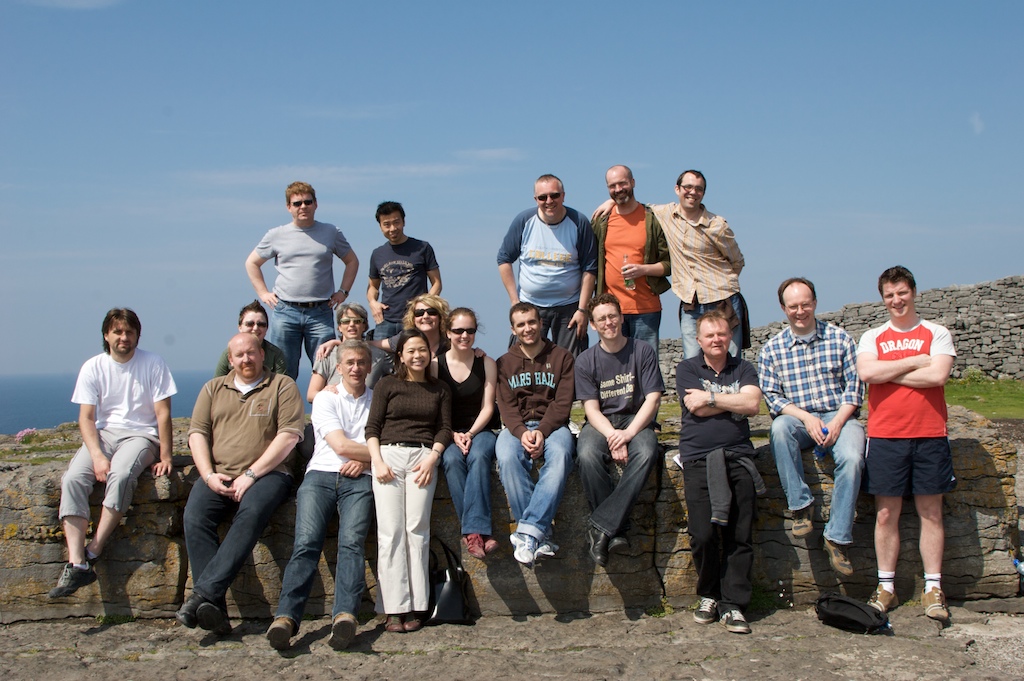
So that on a beautiful summer’s day I find myself cycling along the low road on one of the Aran Islands to spend time with the most diverse, smart, nice and fun bunch of Agilistas I know.
– HATE SOMETHING, CHANGE SOMETHING, MAKE SOMETHING BETTER –
Friday, 16 May 2008
So that on a beautiful summer’s day I find myself cycling along the low road on one of the Aran Islands to spend time with the most diverse, smart, nice and fun bunch of Agilistas I know.
Wednesday, 30 April 2008
I don’t get to go to Paris as often as I’d like, so it’s a real treat to be off to Paris this weekend to present Real Options: l’ultime frontièreat XPDay France on 5 – 6 May. J’espère que vous allez nous rejoindre. À très bientôt.

Thursday, 24 April 2008
Imagine: You nip to the loo in an office building you’re visiting for the first time. After washing your hands, you look into the mirror and what do you see? A see-through sticker with white writing.
Five simple words. Words that send so many alarm bells ringing. Who let the bullies in? Are they still here? Which teams do they work in? Do people take notice of the message? What difference does that one sticker make?
That’s when I notice there are more stickers running along the wall of mirrors, each aligned above a corresponding sink so you can’t ignore the problem. Or so you would think.
It’s lunchtime. I ask about the stickers as I tuck into the tasty weekly Indian meal. It turns out most people around the table don’t really know what bullying means. So I change my question to one of the developers.
‘Does Candy respect you?’ I venture, bold and plain as the nose on my face.
She’s nice. She answers my questions about requirements,’ he replies with a tired but sincere smile.
I meet Candy for the first time that afternoon. Candy’s friendly enough. She smiles back, teeth clenched.
In my experience, respect is the hardest value of all to live by, partly because you have to dig extra deep as it forms the foundation for the other four values. The main reason it’s the toughest to live by is because it’s usually the first thing that most people abandon when the going gets tough.
What does respect mean to you? How would you rate yourself in terms of respect on a scale of 0 – 5 from lowest to highest? Respect begins by recognising, appreciating then leveraging the value each individual brings to a team. How would your team rate you on the scale of respect?
Saturday, 12 April 2008
My manager said to me, ‘The team thinks you’re doing a good job.’ After a short pause he declared, ‘And I agree with them.’ Then a longer pause. I suspected I was in trouble, but I wasn’t sure what for. He continued. ‘The thing is, I’m just not sure what it is you actually do.’
I’m reading a book described as an ‘intimate portrait’ of the current President of France called L’Aube, le Soir ou la Nuit (Dawn, Evening or the Night) by Yasmina Reza. I was surprised to learn that Sarkozy and I have something in common.
In a conversation with Yasmina about young people today, Sarkozy says, ‘Ce qui est un problème c’est quand ils deviennent indépendants et pas gentils, gentils c’est le plus important.’ (‘The problem with young people is that when they grow up they forget about kindness. Being kind is what matters most.’)
That was the gist of the answer I gave my manager all those years ago when he quizzed me about why the team was convinced I was doing a good job. I remember glossing over how I did what I did because my manager graduated from the school of stick-and-carrot management (using the Command and Control Management method). He wouldn’t have understood about consideration for others. I knew this because he had previously expressed concerns about my apparently ‘weaker’ style of management.
Although I couldn’t openly admit to my manager that I worked on the principle of Putting People First back then, the team knew and that was plenty good enough for me.
Putting People First is also about Communication, Simplicity, Feedback, Courage and Respect. Most people I talk to about becoming agile almost always identify respect as the key value from which the others spring.
What’s less well-known is that respect wasn’t in the first version of the published Agile Values. Some say that respect was omitted because it was a given. Surely people know the importance of being respectful towards one another? But even assuming they know about respect, can we trust that they will always behave in a respectful way? Do you? Towards everyone? After all, everyone is valuable.
In a conversation with Pascal about the values at the SPA conference last month, we both agreed that there is a sixth value: Trust. I’ve seen trust, when combined with respect, empowers teams to grow beyond all previous prejudices and perceived limitations. Trust from a manager or team lead is crucial. Trust among team members is equally vital.
What did you do this week to improve the way you work? How can you show you trust your team more?
Sunday, 6 April 2008
London, 6 April 2008, 13.20. Everything is covered in snow. On my way home last night, I ask the taxi driver, ‘Do you believe it’s going to snow tomorrow?’
‘I wouldn’t be surprised if it did. It’s happened once before, so it can certainly happen again,’ he replies.
I can tell Richard is a no-nonsense kind of guy. He doesn’t seem the least bit worried about the uncertainty of the weather. He goes on to tell me he’s already evaluated all his options come rain, snow or shine. He’s a man unfazed by uncertainty.
And so I find myself faced with more questions than when I first started my journey home:
Saturday, 29 March 2008
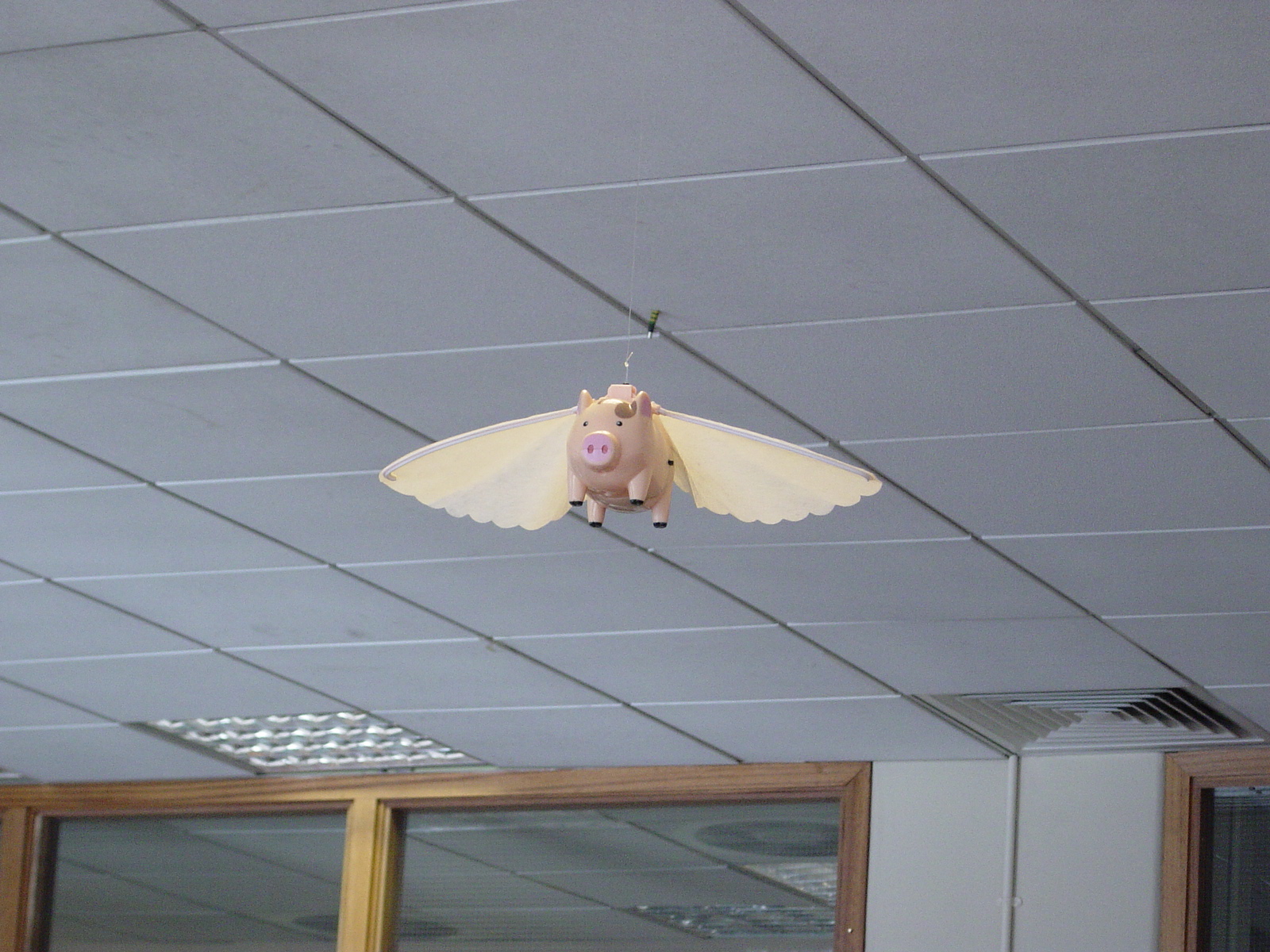
Being an Agile consultant-coach means I’m constantly challenged by what I do, how I do it and, most importantly, why I do it. It never ceases to amaze me how much I learn about myself and others by striving to be agile. Fortunately, that’s one of the things that gives most meaning to the work I do.
I recently presented at SPA and shocked the audience when I alluded to my experience of having been on an Agile death march project.
‘Surely that’s not possible?’ replied the first gasp from the audience.
‘Isn’t that blasphemy?’ resonated a second gasp around the room.
‘I’m intrigued by your negative Agile experience,’ said an Agile coach with a gleeful smile, pen poised, ready to mark me down on my Agile competency.
Why wouldn’t Agile death marches exist? After all, Agile is just another methodology. It’s simply another way of getting people to work together. You can’t immunise your project from failure just because you say you’re doing Agile. Now that would really be make believe. I call it play pretend.
Q: What could possibly be tougher than growing old?
A: Trying to be agile when everyone else believes they are but aren’t.
Earlier this month, I spent a lovely Spring evening with a bunch of young Agile enthusiasts at QCon London and was asked, ‘What would be your top 3 life tips?’ I surprised myself with the following response.
The only real currency we have is time. Invest wisely.
Monday, 28 January 2008
‘It’s not so much where my motivation comes from but rather how it manages to survive.’
– Louise Bourgeois

I went to see the Bourgeois exhibition at Tate Modern last weekend. I couldn’t help but reminisce as I stood marvelling at the gigantic metal spiders like I did exactly ten years ago. Back then, the Dotcom boom had just begun and most business people knew we were onto something big. When the bubble burst, I managed to survive five iterations of staff reduction. All we got from management was radio silence.
It was around that time that I read about a particular social experiment. A group of researchers had enlisted two types of people to test: those who considered themselves optimists and others who considered themselves pessimists.
It was an experiment of two rounds. The first was made up of groups of three, consisting of two optimists and one pessimist. Each group then spent 15 minutes talking to one another.
The point of the experiment was to determine which would be the dominant mindset at the end of the timed period given two different types of influence. Not surprisingly, the majority of groups found themselves feeling more optimistic after the first round.
In the second round, the makeup of the groups changed to one optimist and two pessimists. Again, each group spent 15 minutes talking to one another. What do you think was the outcome?
Participants by and large said they felt more optimistic after the round. What does that outcome tell us about sharing? How can we apply that outcome to stressful situations? When was the last time you talked things over instead of bottled it up?
Thursday, 20 December 2007

I like Christmas. A lot. I’ve come to appreciate Christmas like I do weddings. I feel the same way towards Agile. All three operate on a manifesto of sorts that people can choose to either respect and adhere to or flout and play-pretend.
Everyone just wants to have a good time. And why not? In my experience, practicing Agile is a bit like driving. When you tell people you use Agile to deliver projects, you’re signalling intent, one of collaboration instead of conflict. After signalling comes fulfilment, made real through behaviour and action.
It’s like driving to the shops and indicating you want to turn left and then actually turning left. Unfortunately, many of the Agile drivers I meet signal left and then turn right. These are the same people who wonder why their passenger-team doesn’t believe or trust them to drive safely. Unskilled drivers are a menace to themselves and everyone else on the road.
Agile, like Christmas, creates a culture of shared reality. By having a common and worthwhile goal, one that produces genuine value for instance, people will figure out difficult (impossible) problems like they’ve always done: through co-ordination, cooperation and convergence.
Agile is the ultimate endurance test because it demands openness, stamina, consistency and constancy. What would your project be like if everyone tried their best to get along with one another, do the right thing and do things right? It would be like Christmas. Everyday. For Everyman. How civilised.
Make 2008 matter. Instead of letting others make mincemeat out of you. Thanks for reading. Merry Christmas and a Happy New Year!
Thursday, 29 November 2007
Imagine: It’s 7.30 am. Another fun-filled weekday is only a tube ride away. On your descent down into the station what do you see? Not just one, but two information boards. If you squint you’ll see the sticky tape. The posters are homemade.
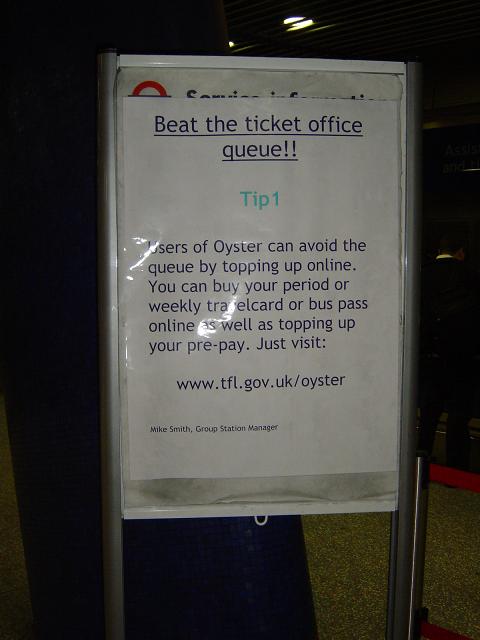
You can tell that whoever put the posters up are doing their best to help. They’re actually offering information. The boards are there to workaround a problem.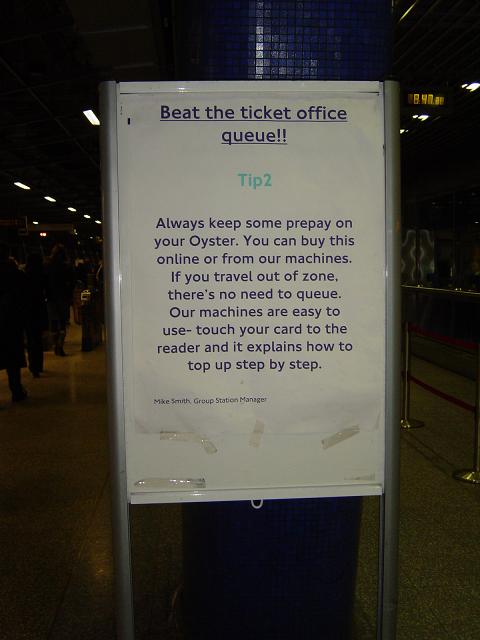
To show my appreciation, I decide to blog about them, so I take some pictures. Someone resembling a station manager approaches me, uncertain of my next move.
‘What are you doing, miss?’ he says.
‘I was just taking some pictures,’ I reply.
Then, as though struck by inspiration for want of something more to say, he says, ‘You’re not allowed to take pictures, miss.’ By this point I feel like a time traveller’s wife, revisiting Dickensian times.
‘But I think these posters are really very useful,’ I say. He smiles. I realise I have his attention, so I ask the question that my friend Jim and I have been asking ourselves for the past three months: ‘Why is the stairwell closed?’ I had speculated that perhaps it was due to a health and safety issue, to which Jim replied at the time, ‘It seems to me the only danger if it were open is that they might actually have to clean it.’
‘I don’t know, miss. I can’t really remember. It seems so long ago,’ replies the nice man.
Suddenly, another official appears on my right and thrusts a card under my nose. ‘Please call this number if you have any complaints,’ he says. This is fast becoming a minor situation. Like the time I was arrested by the Moldovan police.
‘But I don’t wish to complain,’ I reply. ‘I was just asking for information.’
The official who gave me the card stares at me and says, ‘Please. Please call up and complain about the stairwell. THEY haven’t done anything about it for ages. There’s nothing we can do. Someone cut their hand using the staircase ages ago.’
Perhaps that stumbling someone was under the influence I thought, having traversed up and down the staircase on a number of occasions myself and emerged hands intact.
I knew it! The people working at the station were trying to be helpful. They wanted to run the station as best they could. So who are these people known as ‘THEY’ who are blocking instead of helping? How many THEYs and THEMs do you work with? What if I told you there is only US?
Wednesday, 31 October 2007
Question: What do Tom Peters and Steven Levitt have in common?
Answer: They make a living out of having and using a rare and precious thing that has made them kings. Their magic is no secret: it’s common sense.
Tom Peters is a classic great speaker. He’s charming, inspirational and a brilliant performer. It was interesting to hear him speak about excellence in the enterprise 25 years on from when ‘In Search of Excellence’ was first published. According to the title of his talk, he’s ‘Still in Search of Excellence’ – an observation that’s at once disconcerting as well as hopeful. Disconcerting because, from experience, we haven’t solved the problem yet (in spite of the number of man years spent in this pursuit); hopeful because it gives us something to do. Problems are good. It’s often the solutions that make things go from bad to worse. I’m constantly reminded that ‘the road to hell is paved with good intentions.’
Tom began by assuring the audience that we were all leaders – weren’t we? He then went on to say: ‘We all know we’re phonies and because we’re afraid to expose our weaknesses we don’t ask the interesting questions. It’s our job as leaders to ask interesting questions.’
Tom described the essence of enterprise as:
He then hollered a typical management mantra to the crowd like some punk rock star: ‘Park your brain at the door dude and row the slave ship!’ then lowering his voice, he continued: ‘But we have computers to row the slave ship.’
According to Tom, our only chance to succeed in globalisation is to leverage the creative and intellectual skills of our teams. Starbucks is a good example of a human function being replaced by a machine. Since coffee making is done by a machine, what Starbucks buys is individuality in their staff. When asked why Starbucks staff are constantly smiling, one manager said as a matter-of-fact: ‘We hire people who smile.’
Tom, like Levitt, fully acknowledges that he has nothing profound to say. Instead, what he does has been described as ‘blinding flashes of the obvious’. So here’s the latest newsflash: ‘Put your people before your customers,’ says Tom Peters. What will you do?